BlackRock and Bitwise Lower Bitcoin Conversion Minimums, Opening Doors for More Investors
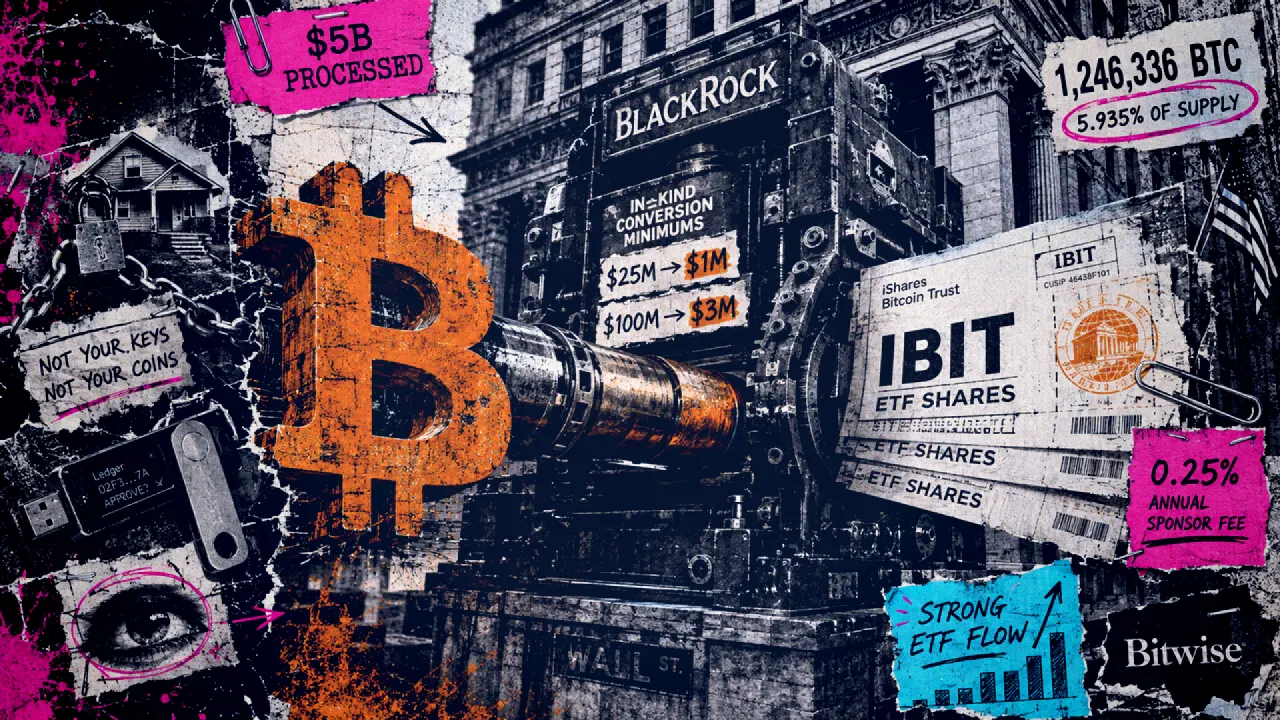
In a significant shift for institutional Bitcoin investments, BlackRock has reduced the minimum for converting privately held Bitcoin into shares of its iShares Bitcoin Trust ETF from $25 million to just $1 million. Bitwise has followed suit, slashing its minimum from $100 million to $3 million. This dramatic reduction in entry barriers is expected to broaden access to Bitcoin investments for family offices and wealthy clients.
BlackRock's program has already processed over $5 billion in transactions since the change was implemented in July 2026. The 96% reduction in the minimum transaction size allows a much larger pool of investors to convert their Bitcoin directly into ETF shares, moving away from the traditional high-threshold model that catered primarily to the wealthiest investors.
Bitwise's adjustment is even more pronounced, with a 97% reduction in its minimum threshold. This change allows investors to maintain exposure to Bitcoin while benefiting from the custody services of the fund. The in-kind conversion process simplifies the transaction, eliminating the need for selling Bitcoin, wiring dollars, and repurchasing exposure through an ETF, thus reducing execution costs and potential tax implications.
While the new $1 million minimum still excludes many potential investors, it marks a significant step towards making Bitcoin investments more accessible. The shift reflects a broader trend in the financial industry, where self-custody is evolving from a permanent identity to a service choice that can be weighed against institutional alternatives.
As the market adapts, the demand for secure custody solutions is growing. Concerns over safety, including incidents of kidnapping and theft, are prompting Bitcoin holders to consider moving their assets into ETFs, which offer a more secure investment structure. The changing landscape of Bitcoin custody and investment is set to reshape how institutional investors approach digital assets.
Updated 22:31 UTC
Latest Developments in Bitcoin Market
- Bitcoin surged above $80,000 for the first time since mid-May, reaching an intraday peak of $81,272.
- In the week ending August 21-22, U.S. spot Bitcoin ETFs saw net inflows of $1.92 billion, with BlackRock's iShares Bitcoin Trust contributing significantly.
- On August 20, daily inflows into Bitcoin ETFs reached $606 million.
- The U.S. Treasury announced plans to double its government bond buyback operations to approximately $4 billion per session starting in early September.
- Bitcoin's recovery from its late-June low of approximately $58,000 represents a 38% increase over two months.
- Analysts caution against declaring a new bull market, suggesting the recent surge is more of a catch-up trade influenced by macroeconomic factors.
Updated 05:00 UTC
New Facts on Bitcoin's Recent Surge
- Bitcoin (BTC) experienced a remarkable gain of $14,775 in a single week, marking the largest one-week dollar increase in its history.
- The weekly close for Bitcoin jumped from $62,818 to $77,593, representing a 23.5% increase, which is the 41st highest percentage increase since 2010.
- This surge was attributed to two main catalysts: the US Treasury's announcement to double long-bond buyback operations and President Trump's call for Congress to pass the CLARITY Act.
- Approximately $2.7 billion in short positions were liquidated across crypto markets during this period, contributing to Bitcoin's rapid bull flip.
- The Crypto Fear and Greed Index reached 74 on August 25, its highest level since October 2025, indicating a significant shift in market sentiment.
- Weekly inflows into Bitcoin ETFs were the strongest since October 2025, suggesting a rebound in demand.
- August is projected to record the largest monthly net inflow since Bitcoin's previous all-time high, reversing months of ETF outflows.
- Despite the recent rebound, ETF holders remain approximately 6% underwater, with an average cost basis of $84,029 compared to a current spot price of $78,955.
Updated 05:30 UTC
New Facts on Bitcoin ETFs
- As of August 27, 2026, spot Bitcoin ETFs recorded $242 million in net inflows, extending their inflow streak to nine consecutive trading days.
- Spot Ethereum ETFs matched this trend, adding $235 million on the same day, also marking their ninth straight inflow session.
- BlackRock’s iShares Bitcoin Trust contributed $209 million of a $338 million Bitcoin ETF inflow on August 24, 2026.
- Bitcoin traded near $80,000, reflecting a 2.12% increase over 24 hours as of the latest report.
- Total net assets across spot Bitcoin ETFs reached $79.16 billion, with trading volume across the category at $8.23 billion according to CoinGlass data.
- Smaller crypto funds, including spot Solana ETFs and spot Hyperliquid ETFs, added $60.91 million and $24.42 million, respectively, on August 27, 2026.
FAQ
What are the new minimum conversion amounts for BlackRock and Bitwise Bitcoin ETFs?
BlackRock has reduced its minimum conversion amount from $25 million to $1 million, while Bitwise has lowered its minimum from $100 million to $3 million.
How has the reduction in minimums affected investor access to Bitcoin investments?
The significant reduction in minimum transaction sizes allows a larger pool of investors, including family offices and wealthy clients, to convert their Bitcoin directly into ETF shares, making Bitcoin investments more accessible.
What advantages does the in-kind conversion process offer for Bitcoin investors?
The in-kind conversion process simplifies transactions by eliminating the need to sell Bitcoin, wire dollars, and repurchase exposure through an ETF, thus reducing execution costs and potential tax implications.
Why are Bitcoin holders considering moving their assets into ETFs?
Concerns over safety, including risks of kidnapping and theft, are prompting Bitcoin holders to consider ETFs, which provide a more secure investment structure and custody solutions.
What broader trend is reflected in the changes to Bitcoin investment accessibility?
The changes reflect a broader trend in the financial industry where self-custody is evolving into a service choice, highlighting the growing demand for secure custody solutions for digital assets.
Comments
Comments are moderated before publish.
No comments yet — be the first.