Cardano and Solana Highlight Governance Challenges in Crypto Networks
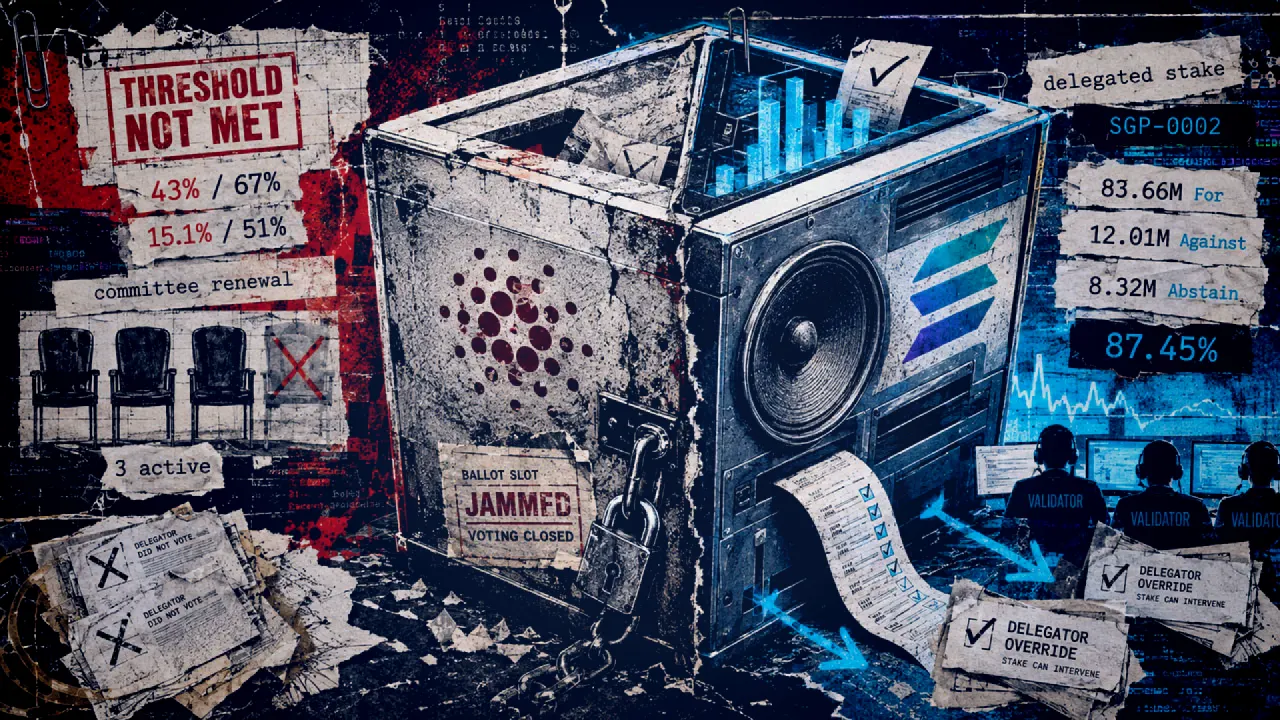
Cardano and Solana are currently exploring two distinct approaches to on-chain governance, each exposing critical weaknesses in voter participation and representation. Cardano's governance model requires approval from both delegated representatives (DReps) and stake pool operators, while Solana allows validators to vote on behalf of stakers unless overridden by individual users.
Recent snapshots reveal that Cardano is facing immediate governance risks, as a proposal for renewing its constitutional committee fell short of the necessary support from both DReps and stake pool operators. As of August 26, only 43% of DReps and 15.1% of stake pool operators supported the proposal, which requires a minimum of 67% and 51% respectively. If the proposal fails, Cardano could be left with insufficient committee members to conduct governance actions, although it would not halt block production.
In contrast, Solana's governance model aims to mitigate participation bottlenecks by allowing validators to represent passive stakers. However, this system raises concerns about potential conflicts of interest, as validators may have financial stakes in the proposals they vote on. The recent governance vote on Solana showed significant support for a proposal to accelerate SOL disinflation, but the interpretation of voting rules remains ambiguous, complicating the assessment of the outcome.
Both networks illustrate the ongoing challenges of on-chain governance, with Cardano's model emphasizing the risks of voter apathy and Solana's approach highlighting the complexities of representation and incentive alignment. As both networks move forward, the effectiveness of their governance structures will be closely scrutinized.
FAQ
What are the governance models of Cardano and Solana?
Cardano's governance model requires approval from both delegated representatives (DReps) and stake pool operators, while Solana allows validators to vote on behalf of stakers unless overridden by individual users.
What recent governance challenge is Cardano facing?
Cardano is facing immediate governance risks due to a proposal for renewing its constitutional committee that fell short of the necessary support from both DReps and stake pool operators.
What percentage of DReps and stake pool operators supported Cardano's recent proposal?
As of August 26, only 43% of DReps and 15.1% of stake pool operators supported the proposal, which requires a minimum of 67% and 51% respectively to pass.
How does Solana's governance model address voter participation?
Solana's governance model aims to mitigate participation bottlenecks by allowing validators to represent passive stakers, thus enabling more efficient voting.
What concerns arise from Solana's governance model?
Solana's model raises concerns about potential conflicts of interest, as validators may have financial stakes in the proposals they vote on, complicating the assessment of voting outcomes.
Comments
Comments are moderated before publish.
No comments yet — be the first.