East Texas A&M University Develops Quantum-Proof Defense for Bitcoin's Lightning Network
On September 12, 2026, a team from East Texas A&M University unveiled PQLN (Post-Quantum Lightning Network), marking the first implementation of quantum-resistant cryptography for Bitcoin's Lightning Network. This development aims to safeguard the network against potential threats posed by quantum computers.
The Lightning Network facilitates off-chain transactions for Bitcoin users, allowing for quicker payments without waiting for blockchain confirmations. However, it relies on the same elliptic curve cryptography (secp256k1) that secures Bitcoin, which could be compromised by sufficiently powerful quantum computers. PQLN enhances the existing system by integrating lattice-based algorithms, specifically ML-DSA for digital signatures and ML-KEM for key exchange, without discarding the current cryptographic framework.
PQLN focuses on five critical operations within the Lightning Network: gossip (information sharing among nodes), peer transport, invoices, payment onions (routing privacy), and offers, all structured under the BOLT specification framework. The implementation allows upgraded nodes to maintain communication with legacy nodes, ensuring interoperability.
Performance tests indicate that the additional cryptographic operations introduce minimal latency, averaging 0.33 milliseconds per operation. However, the bandwidth required for gossip downloads increases significantly, approximately tenfold under PQLN's default settings, although alternative signature schemes like Falcon can reduce this overhead.
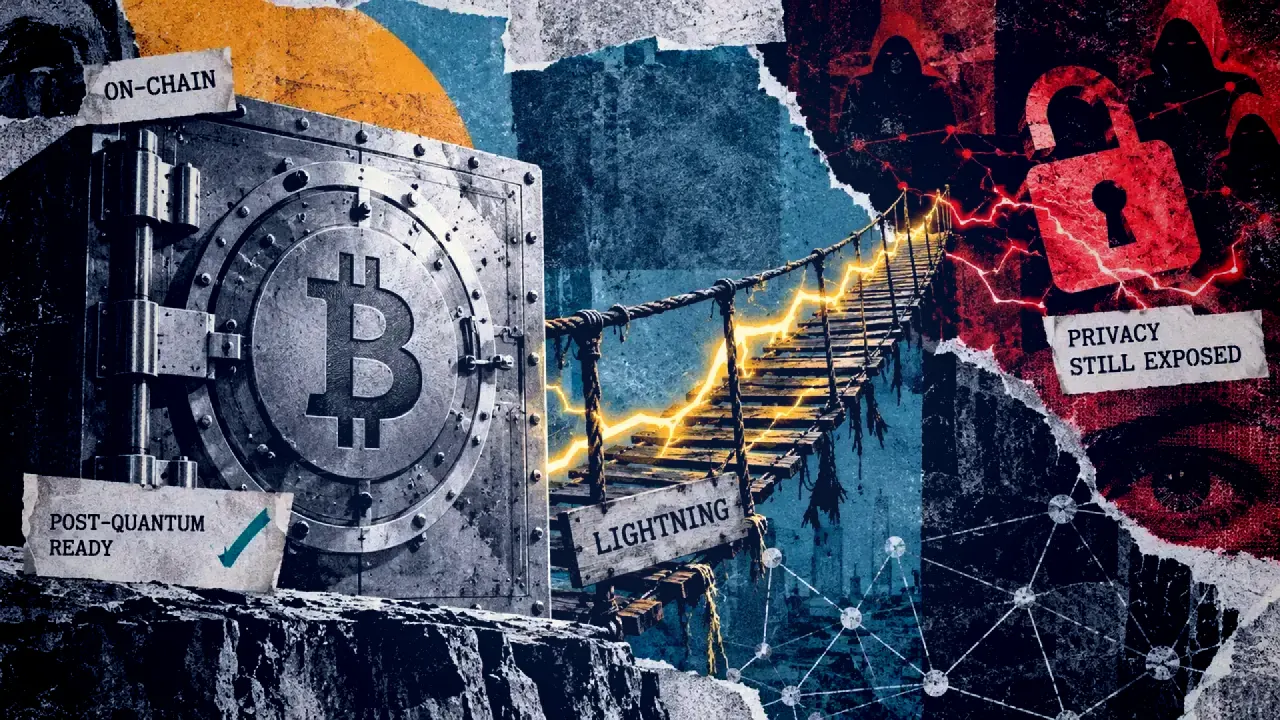
Despite its advancements, PQLN has limitations. It secures the communication and routing layers of the Lightning Network but does not protect channel funds or on-chain Bitcoin elements. This is due to the necessity of a consensus upgrade for any changes to Bitcoin's base layer cryptography, requiring agreement from the entire network of miners and node operators.
The introduction of PQLN has sparked discussions within the Bitcoin community, with its open-source codebase available for further study and potential adoption by other Lightning implementations.
FAQ
What is PQLN?
PQLN (Post-Quantum Lightning Network) is a quantum-resistant cryptography implementation for Bitcoin's Lightning Network developed by East Texas A&M University to protect against threats from quantum computers.
How does PQLN enhance the Lightning Network?
PQLN enhances the Lightning Network by integrating lattice-based algorithms for digital signatures and key exchange, allowing for secure off-chain transactions while maintaining compatibility with existing systems.
What are the critical operations that PQLN focuses on?
PQLN focuses on five critical operations within the Lightning Network: gossip, peer transport, invoices, payment onions, and offers, all structured under the BOLT specification framework.
What are the performance implications of PQLN?
Performance tests show that PQLN introduces minimal latency, averaging 0.33 milliseconds per operation, but significantly increases the bandwidth required for gossip downloads, approximately tenfold under default settings.
What are the limitations of PQLN?
PQLN secures the communication and routing layers of the Lightning Network but does not protect channel funds or on-chain Bitcoin elements, as changes to Bitcoin's base layer cryptography require a consensus upgrade from the entire network.
Comments
Comments are moderated before publish.
No comments yet — be the first.