Bitcoin Researchers Propose Shielded Transfers to Enhance Privacy on the Network
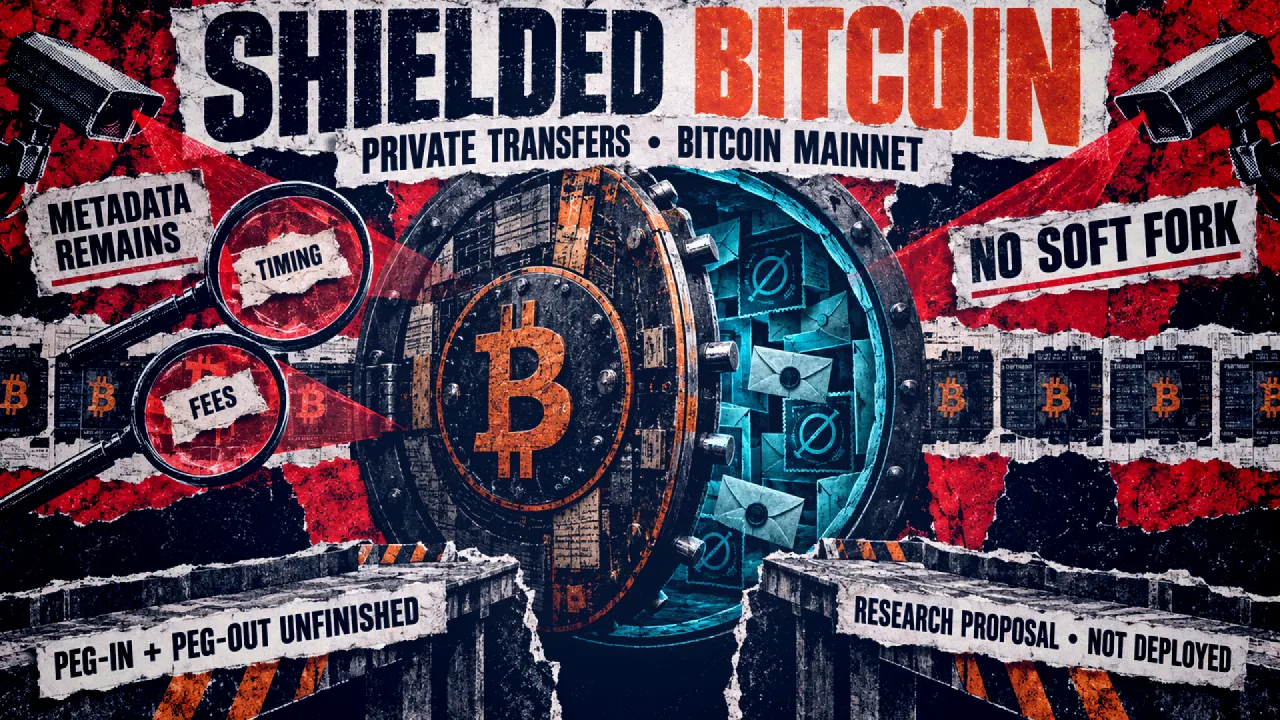
Bitcoin researchers have unveiled a proposal for implementing private transfers directly on the Bitcoin network, termed Shielded Bitcoin. This system, introduced in a paper published on September 24 by researchers Clara Shikhelman, Mikhail Komarov, and Aleksei Moskvin, aims to enhance transaction privacy without necessitating a soft fork or modifications to Bitcoin's consensus rules.
Shielded Bitcoin employs a metaprotocol designed to obscure transaction amounts, senders, recipients, and the connections between transfers, while still publishing protocol data on the Bitcoin mainnet. The design draws from methodologies established by Zcash, such as encrypted notes, public nullifiers, and zero-knowledge proofs, but maintains Bitcoin's existing blockchain structure.
The proposal allows users to hold Bitcoin-denominated value as encrypted notes. When transferring funds, the sender publishes an envelope containing encrypted outputs, public nullifiers that mark previously held notes as spent, and a zero-knowledge proof that confirms ownership and value conservation. This ensures that the amount transferred and the identities of the involved parties remain confidential.
Unlike Zcash, where the network's consensus rules directly validate shielded transactions, Shielded Bitcoin operates above Bitcoin's consensus layer. Miners and nodes will not validate the shielded state; instead, implementations will scan Bitcoin blocks and replay accepted transfer envelopes to reconstruct the private transaction state.
While the design is innovative, it currently lacks a mechanism for moving ordinary Bitcoin into and out of the shielded system. The proposal anticipates using its PIPEs v2 work for these processes, but details on achieving trustless and private entry and exit remain unresolved.
As privacy-focused cryptocurrencies gain renewed interest, the Shielded Bitcoin proposal could pose a challenge to dedicated privacy networks like Zcash. André Dragosch from Bitwise Europe noted that this development might diminish the technological edge that privacy coins have traditionally held over Bitcoin.
In a related note, Zcash co-founder Eli Ben-Sasson expressed support for the Shielded Bitcoin initiative, highlighting its alignment with the original vision of integrating privacy into Bitcoin's base layer. He also reiterated his optimistic year-end price target for ZEC, which has seen significant gains recently.
FAQ
What is Shielded Bitcoin?
Shielded Bitcoin is a proposal for implementing private transfers directly on the Bitcoin network, designed to enhance transaction privacy without requiring changes to Bitcoin's consensus rules.
How does Shielded Bitcoin ensure transaction privacy?
It employs a metaprotocol that obscures transaction amounts, senders, recipients, and the connections between transfers, while still publishing protocol data on the Bitcoin mainnet using methods like encrypted notes and zero-knowledge proofs.
Will Shielded Bitcoin require a soft fork?
No, the proposal does not necessitate a soft fork or modifications to Bitcoin's consensus rules, operating above the consensus layer instead.
What are the current limitations of Shielded Bitcoin?
Currently, there is no mechanism for moving ordinary Bitcoin into and out of the shielded system, and details on achieving trustless and private entry and exit remain unresolved.
How does the Shielded Bitcoin proposal affect other privacy-focused cryptocurrencies?
The proposal could challenge dedicated privacy networks like Zcash by diminishing the technological edge these privacy coins have traditionally held over Bitcoin, as noted by industry experts.
Comments
Comments are moderated before publish.
No comments yet — be the first.