Ethereum and Solana Face Native Token Demand Challenges Amid Stablecoin Growth
Recent discussions highlight a growing trend where stablecoin users are bypassing Ethereum (ETH) and Solana (SOL) in favor of gasless transactions. This shift raises concerns about the future demand for these networks' native tokens.
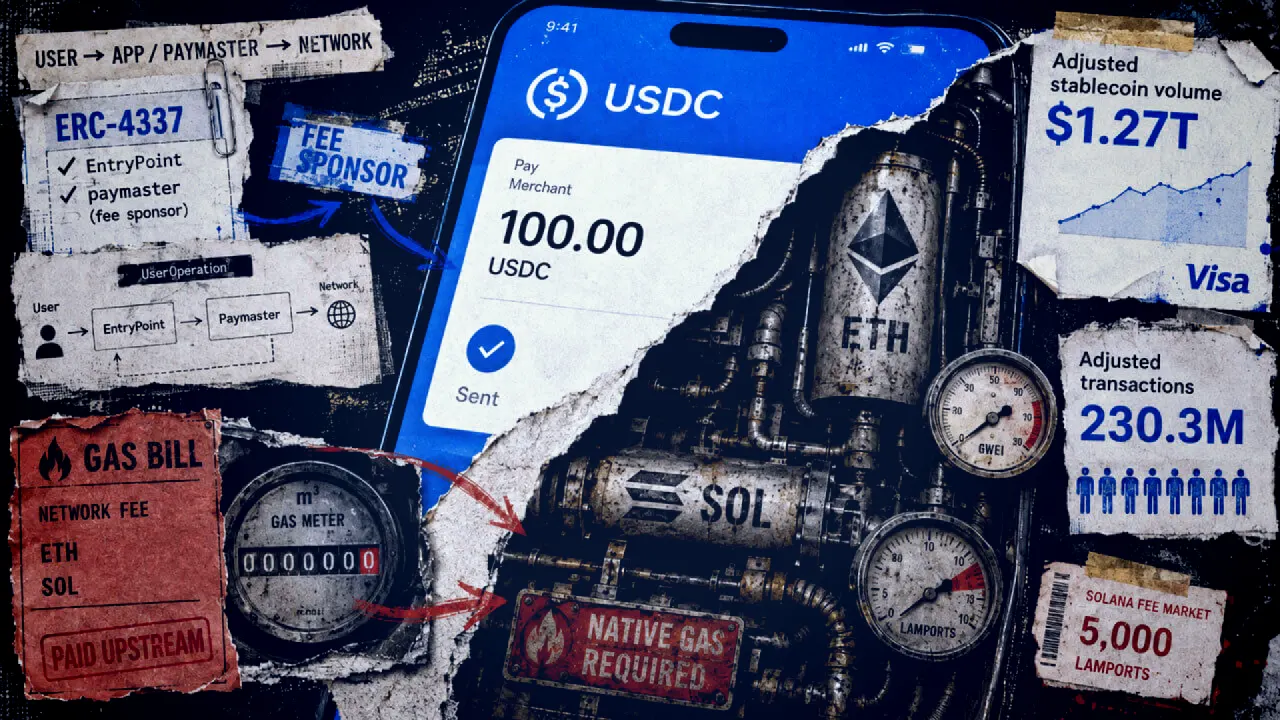
Matt Corallo noted that applications are allowing users to send and receive USDC without needing to hold ETH or SOL, effectively obscuring the need for native token balances. Despite this, the underlying network fees are still settled in the respective native assets, which could impact their demand.
According to Visa's Onchain Analytics, stablecoin transactions reached approximately $1.3 trillion in adjusted volume over a recent 30-day period, indicating a substantial reliance on stablecoins for transactions. This trend suggests that while user experience may improve, the economic implications for ETH and SOL could be significant.
Ethereum's ERC-4337 introduces a model where a paymaster can cover transaction fees, allowing users to interact with the network without holding ETH. This could lead to a decrease in the necessity for users to maintain a native token balance, shifting the responsibility to service providers who manage these fees.
Similarly, Solana's fee structure allows for transactions to be sponsored, meaning users can conduct operations without holding SOL. However, this also implies that the demand for SOL may not reflect the actual transaction activity on the network.
As stablecoin adoption continues to grow, the architecture of these networks may shift, reducing the need for individual users to hold native tokens while placing the onus of fee management on a smaller number of service providers.
FAQ
Why are stablecoin users bypassing Ethereum and Solana?
Stablecoin users are opting for gasless transactions that do not require holding native tokens like ETH or SOL, which simplifies the user experience.
What impact does the shift to gasless transactions have on the demand for ETH and SOL?
The shift may reduce the demand for ETH and SOL as users no longer need to hold these tokens to transact, potentially affecting their market value.
How do Ethereum's ERC-4337 and Solana's fee structure accommodate gasless transactions?
Ethereum's ERC-4337 allows a paymaster to cover transaction fees, while Solana's fee structure permits sponsored transactions, enabling users to operate without holding native tokens.
What are the economic implications of increased stablecoin transactions?
With stablecoin transactions reaching approximately $1.3 trillion in a recent 30-day period, the reliance on stablecoins may diminish the necessity for users to hold native tokens, impacting the overall demand for ETH and SOL.
Will the architecture of Ethereum and Solana change due to stablecoin adoption?
Yes, as stablecoin adoption grows, the architecture of these networks may evolve, reducing the need for individual users to hold native tokens and shifting fee management responsibilities to service providers.
Comments
Comments are moderated before publish.
No comments yet — be the first.