SEC and CFTC Implement New Crypto Access Paths Following CLARITY Act Setback
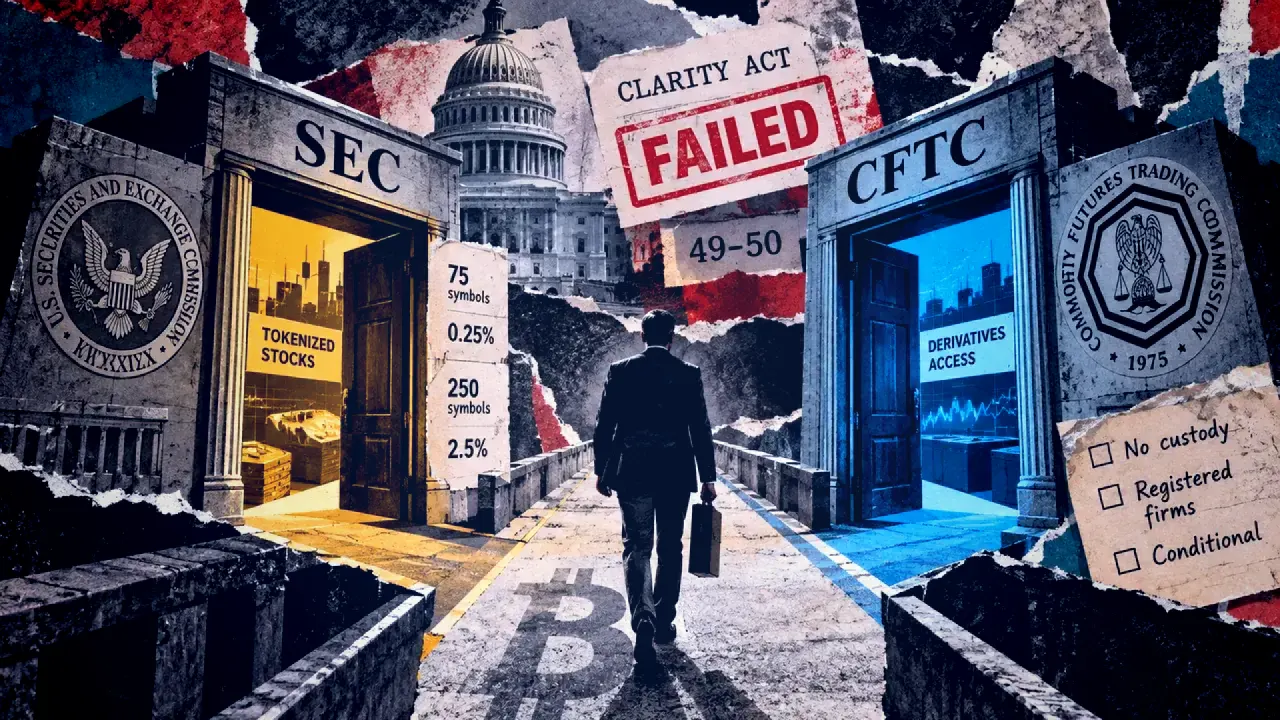
In a significant move following the Senate's rejection of the CLARITY Act, the U.S. Securities and Exchange Commission (SEC) and the Commodity Futures Trading Commission (CFTC) have unveiled new pathways for crypto market access. These actions come as federal regulators seek to navigate the complexities of the crypto landscape without congressional approval.
SEC's New Framework for Tokenized Stocks
On September 17, the SEC announced a five-year framework allowing permissioned venues to trade tokenized U.S. stocks through automated market makers. This initiative, termed the Tokenized Securities Venue (TSV), permits qualifying venues to facilitate trades without being classified as exchanges under the Exchange Act. However, the SEC's approach is capped and conditional, limiting the number of stocks and trading volumes.
- Tier 1 stocks are limited to 75 symbols and 0.25% of the prior month's average daily share volume.
- Tier 2 stocks can include up to 250 symbols and 2.5% of average daily share volume.
- Tokenized stocks must maintain the economic and governance rights of traditional shares.
Additionally, before a TSV can trade stock tokenized by an unaffiliated third party, it must notify the issuer and allow for a 30-day objection period.
CFTC's Proposal for Crypto Market Structure
Simultaneously, the CFTC has submitted a proposal to the White House's Office of Management and Budget (OMB) aimed at establishing rules for crypto asset transactions and markets. This proposal seeks to create a new category of 'crypto asset market' for eligible exchanges and allow for leveraged trading of crypto assets. CFTC Chairman Michael Selig indicated that this initiative is a response to the stalled CLARITY Act and aims to provide regulatory clarity in the crypto space.
The CFTC's proposal is currently under OMB review and may undergo revisions before being returned for a vote. If approved, the agency will seek public comments before finalizing the rules.
Implications for the Crypto Market
Both the SEC and CFTC's actions illustrate a shift towards regulatory frameworks that aim to address the growing demand for crypto trading while maintaining existing market safeguards. However, the limitations imposed by these new measures highlight the ongoing challenges in establishing a comprehensive regulatory environment for digital assets.
Updated 14:02 UTC
New Developments in Crypto Regulation
On September 17, 2023, the Commodity Futures Trading Commission (CFTC) submitted a proposed rulemaking titled "Regulation Crypto Asset Transactions and Regulation Crypto Asset Markets" to the White House Office of Information and Regulatory Affairs. This move follows the Senate's recent rejection of the CLARITY Act, which aimed to establish a comprehensive regulatory framework for digital assets.
The CFTC's proposal is focused on creating a designated contract market (DCM) framework specifically for crypto assets, potentially allowing for leveraged trading on both registered and non-registered exchanges. CFTC Chair Michael S. Selig had previously directed staff to explore rules surrounding crypto market structure, indicating a proactive approach to regulation.
The proposed rules have not yet been made public, and the formal notice-and-comment period will reveal the specific compliance requirements and operational mandates. This initiative could provide a regulatory pathway for US exchanges to offer products they have been hesitant to launch, particularly in leveraged trading.
However, the jurisdictional conflict between the CFTC and the SEC remains unresolved, as the SEC has not indicated any intention to relinquish its stance on digital assets classified as securities. This ongoing tension could complicate the regulatory landscape as the CFTC moves forward with its rulemaking.
Updated 14:02 UTC
New Developments in Crypto Regulation
- The U.S. Commodity Futures Trading Commission (CFTC) has initiated a new rulemaking to regulate crypto transactions and markets.
- This move is part of a broader effort by CFTC Chairman Michael Selig to create a crypto market-structure framework using existing authority.
- The rulemaking coincides with ongoing congressional debates over the CLARITY Act, heightening the focus on the regulatory landscape for digital assets in the U.S.
- Market reactions indicate a perceived increase in regulatory uncertainty, potentially affecting future price expectations for cryptocurrencies.
- Current market pricing reflects only a 1% probability of Bitcoin reaching $200,000 by December 31, 2026, suggesting skepticism regarding price growth under new regulatory conditions.
- Observers are monitoring the implementation of the CFTC’s rulemaking and its potential impact on crypto market behavior.
Updated 15:02 UTC
New Developments in Crypto Regulation
The U.S. Commodity Futures Trading Commission (CFTC) has submitted draft rules for regulating crypto markets to the White House for review. This submission comes as the CLARITY Act remains stalled in the Senate after a narrow procedural vote failure.
The draft rules, titled “Regulation Crypto Asset Transactions and Regulation Crypto Asset Markets,” aim to establish a regulatory framework for digital assets. However, this submission does not finalize any regulations, marking an early phase in the federal rulemaking process.
Market pricing indicates a decreased likelihood of the CLARITY Act being signed into law by 2026, with current odds stabilizing at 8% for a YES vote following a previous drop.
Observers are closely monitoring the White House review process for any indications of the administration’s stance on crypto regulation, as well as potential public statements from President Trump or his administration regarding the CLARITY Act.
FAQ
What is the Tokenized Securities Venue (TSV) announced by the SEC?
The Tokenized Securities Venue (TSV) is a five-year framework allowing permissioned venues to trade tokenized U.S. stocks through automated market makers, without being classified as exchanges under the Exchange Act.
What are the limitations on trading tokenized stocks under the SEC's new framework?
The SEC's framework limits Tier 1 stocks to 75 symbols and 0.25% of the prior month's average daily share volume, while Tier 2 stocks can include up to 250 symbols and 2.5% of average daily share volume.
What is the CFTC's proposal regarding crypto asset transactions?
The CFTC has proposed establishing rules for crypto asset transactions and markets, creating a new category of 'crypto asset market' for eligible exchanges and allowing for leveraged trading of crypto assets.
How does the SEC's and CFTC's actions relate to the CLARITY Act?
Both the SEC and CFTC's actions are responses to the Senate's rejection of the CLARITY Act, aiming to provide regulatory clarity in the crypto space without congressional approval.
What are the next steps for the CFTC's proposal?
The CFTC's proposal is currently under review by the White House's Office of Management and Budget (OMB) and may undergo revisions before being returned for a vote. If approved, public comments will be sought before finalizing the rules.
Comments
Comments are moderated before publish.
No comments yet — be the first.